Operational context
APPLICATIONA mortgage drafting workflow has products, audiences, channels, and jurisdictions.
ARCHITECTURAL PURPOSEDetermine which approved constraints apply to the specific action.
 Product story · September 2026
What governs this action, right now? The question began with preserving authority in Scripture restoration and developed through regulated software. CompliLend™ became one working proving ground. GSC Core™ is the shared governance foundation, and CompliLenz™ is its commercial expression.
Software learned how to execute. Now it must learn what governs execution.
From founder-led development toward independent review and controlled evaluation.
This is a product story, not an audit report or certification. The images below show a CompliLend™ staging demonstration. They do not establish production readiness or independently verify server-side enforcement.
A policy only helps if it informs the next decision.
Governance State Computing is designed to determine which approved authorities and constraints apply to an action in its operational context, before that action proceeds.
Think of it as a lens placed in front of a decision.
The intended result is practical: allow the action, require a change, route it for review, or block it. The governing outcome and its supporting evidence should remain available for later examination.
Different subjects revealed a recurring need: connect authority to the work being performed.
While developing a governed process for Hebrew Scripture restoration, Kimberly Resch encountered a problem that reached beyond translation: how to keep sources, terminology, and decisions consistent across repeated work.
The Compli series began with CompliLaw™ and expanded into other regulated workflows. CompliLend™ brought the governance question into mortgage communications, while CompliLead™ explored lead operations.
The staging workspace brings document governance, contextual information, draft review, and event history into one workflow. The selected screens below illustrate parts of that experience.
Recurring needs across the applications led to a shared governance architecture. GSC Core™ names that reusable foundation, rather than a lending-specific application.
The work led to a U.S. provisional patent application titled “Systems and Methods for Executable Governance of Regulated Operations.” A provisional application is not a granted patent.
CompliLenz™ is designed to bring the governance approach into organizations’ existing workflows, with their own software remaining the system of origin and execution.
A clear distinction between visible product behavior, design intent, and independent assurance.
Selected frames show a workspace dashboard, a draft marked for review, and an approval queue.
These screens belong to CompliLend™, not to a production CompliLenz™ client deployment.
Independent review and controlled evaluation are separate steps. This page does not claim that they have been completed.
The distinction matters: a visible review notice illustrates the intended workflow. Verifying that a control cannot be bypassed requires testing beyond a screenshot.
Selected frames from the supplied staging walkthrough. Historical screens retain their original “CompliLend OS” interface label; the public product name is CompliLend™.
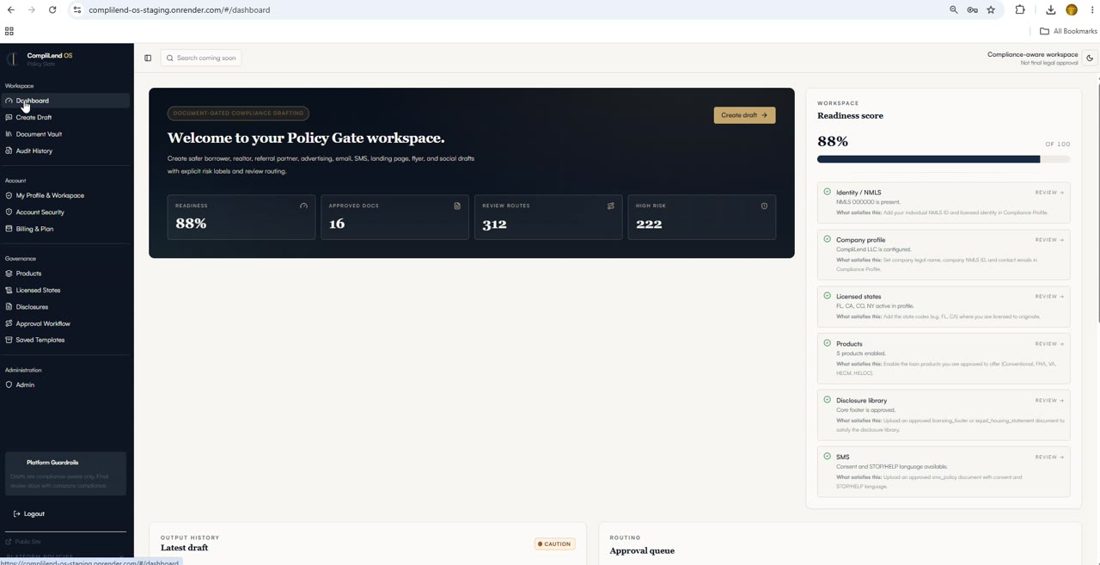
The dashboard displays a readiness score, document counts, and review indicators. These are values shown in the demonstration, not independently verified performance or compliance measures.
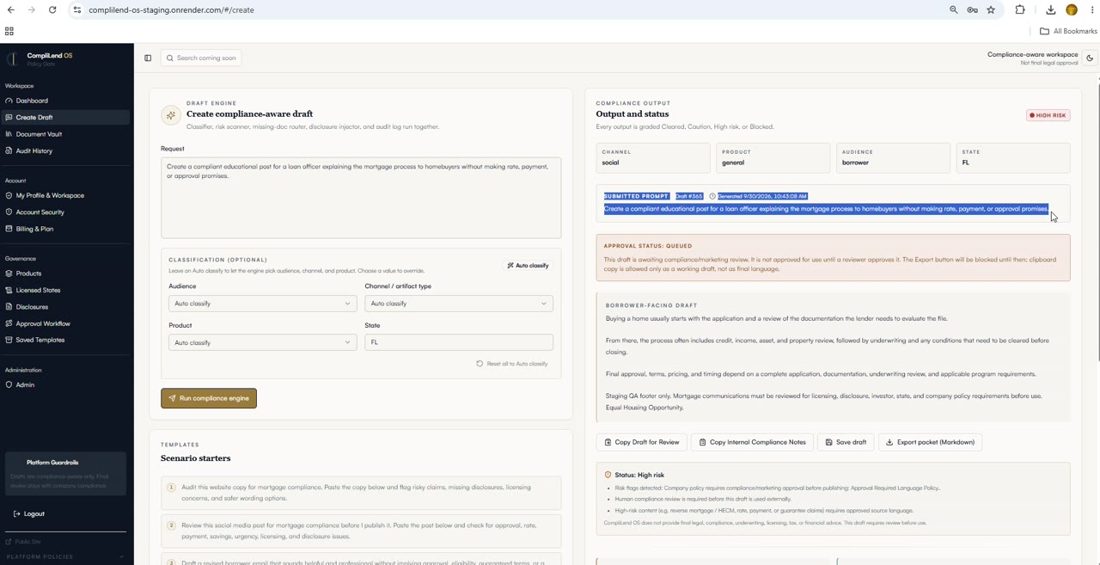
The displayed draft is labeled High Risk and Queued. A notice says it is awaiting compliance or marketing review and is not approved for use until a reviewer approves it.
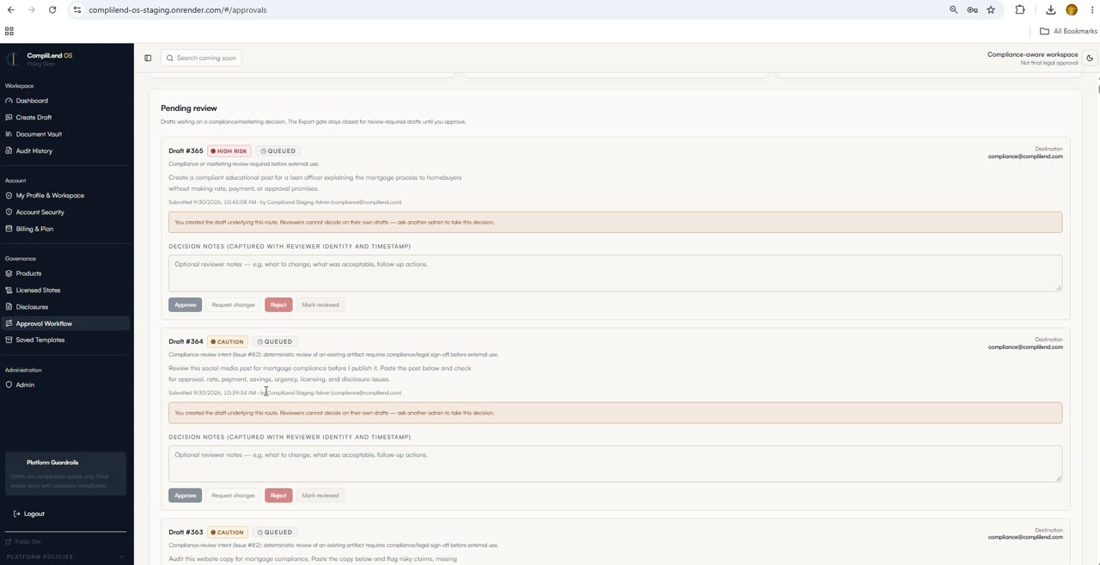
The queue displays draft status and decision controls. A notice says that reviewers cannot decide on their own drafts. The screen illustrates the intended separation of responsibilities; it does not by itself prove enforcement.
The product illustrates the problem. The architecture is designed to address it across different workflows.
APPLICATIONA mortgage drafting workflow has products, audiences, channels, and jurisdictions.
ARCHITECTURAL PURPOSEDetermine which approved constraints apply to the specific action.
APPLICATIONA draft can be marked for review in a designated queue.
ARCHITECTURAL PURPOSEConnect the governing outcome to an appropriate next step.
APPLICATIONA workspace provides visibility into activity and decisions.
ARCHITECTURAL PURPOSEPreserve evidence that supports examination of a governing outcome.
APPLICATIONCompliLend™ brings these needs into a focused application.
ARCHITECTURAL PURPOSECompliLenz™ is designed to work alongside existing organizational systems.
Identify a need for change or review before an action proceeds.
Apply approved authority in context across repeated work.
Make the path to human review and approval explicit.
Keep the basis of a governing result available for examination.
Bring governance into workflows without making wholesale replacement the goal.
Apply the same governance approach across different operational domains.
The next stages are intended to test the approach, identify its limits, and establish evidence in a defined setting.
Evaluate a defined version and document findings.
Address findings and test the affected behavior again.
Exercise a bounded workflow with appropriate safeguards.
Assess the results before expanding the scope.